Testimony of Claudia Grooten – Daughter of a Belgian volunteer who fought in the Korean War
Interview with Claudia Grooten, daughter of Belgian veteran Martinus Grooten, who volunteered to fight in the Korean War.
Seventy years after the end of the Korean War, the memory of those who fought in it continues to resonate beyond national borders. Last month, a solemn tribute was paid in Woluwe-Saint-Pierre to the Belgian veterans who took part in this conflict, often described as the “Forgotten War”, yet one whose scars and bonds remain deeply etched (link to the article on the tribute here).
It is in this context that I share with you today the testimony of Claudia Grooten, recorded following this commemorative ceremony.
As her mother tongue is Dutch, a faithful translation was carried out in order to preserve the authenticity and accuracy of her words.
Her statements have been transcribed word for word, with full respect for her expression and sensitivity.
The origins of a veteran’s commitment
Can you tell me what your family relationship is to the veteran and what you know about his service?
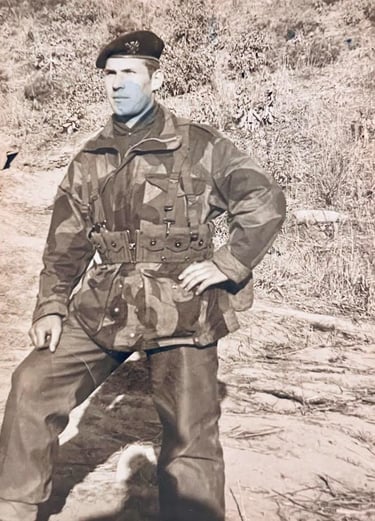
The veteran is my father. He served in Korea from 3 January 1953 to 4 December 1953 as a soldier in Company C.
He carried out patrols and reconnaissance missions with his comrades. At times, they came under enemy fire, and one day he suddenly lost contact with his companions — they were never found.
They sometimes had to remain completely still for several days, transmitting their observations by radio to their command post.
He witnessed things he would never forget, combat scenes forever engraved in his memory. He returned home with his arm in a cast.
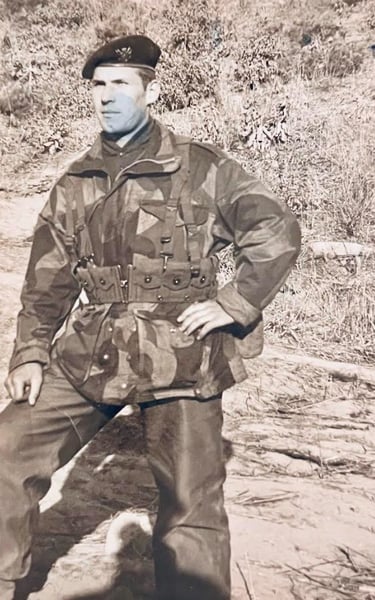
Grooten Martinus during Korean war - 1953
The decision to leave
What did he tell you about the circumstances that led him to leave for Korea?
He hardly spoke about it in the past, but in recent years he has begun to open up. He is now 94 years old.
He was young and impulsive, and after an argument with his mother, he signed up in a fit of anger to leave as a volunteer for Korea.
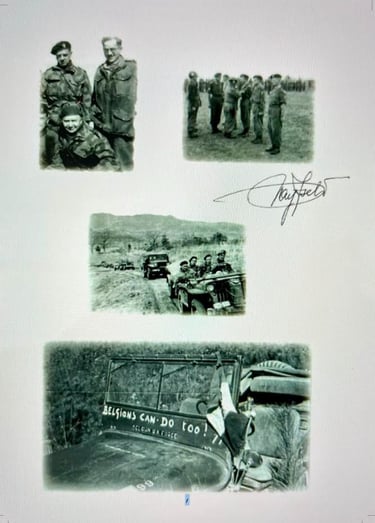
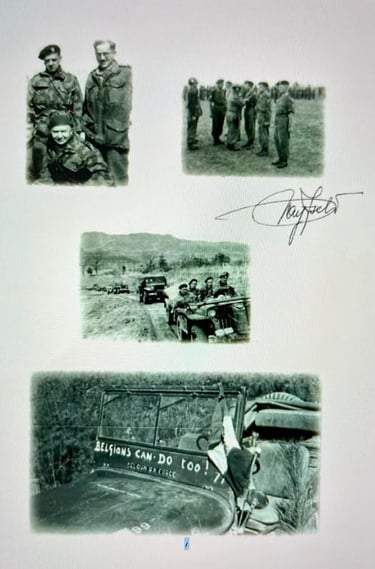
Among the Belgian veterans, their motto was: “Belgians can do too!”
In your opinion, what were his main motivations for volunteering for such a distant conflict ?
He was a soldier in the Belgian army and had made a few mistakes that caused him to lose his rank. He believed that by volunteering for Korea, he could regain his stripes within the Belgian army.
Memories
Have you kept any letters, objects or photographs from his time in Korea ?
Yes, we have many photographs from his time in Korea, of him and his comrades. There are probably also letters, but he still keeps them in his possession.
Living with the memories of war
What feelings or images come to mind when you think about this period of his life?
I have great admiration for all the veterans I know. I have even had the honour of becoming president of their association.
Their stories, like those of my father, are always deeply moving.
There are still several veterans alive, and I am fortunate to welcome around twenty of them to our activities, as long as they are still able to travel.
I believe that, for them, this period remains a dark one: many comrades fell or were reported missing. They saw so many dead and wounded… It must have been a terrible time, one they often prefer not to speak about.
Bonds of friendship and brotherhood with Korean soldiers
How did he describe his relationships with Korean soldiers and the local population ?
The Belgians were highly appreciated by the Korean population.
They trained and supported the Korean soldiers, who in turn provided them with great assistance in the field.
True friendships were forged through this brotherhood in arms; bonds that lasted a lifetime.
Did he mention anything in particular about the culture, the country or the people he encountered there ?
He used to say :
“Korea is a magnificent country, inhabited by people who are deeply grateful for what the Belgian volunteers did for them.
We are keen to preserve this bond, and this country will always remain in our hearts.
We, the Korean War veterans, are proud to have contributed, in our own way, to the building of world peace.
We have no doubt that future generations will continue, out of respect for the past, to build a better world.”
The Belgians, nicknamed the Brown Berets, were called “Pirogi”.
Wherever they went afterwards, they were welcomed by joyful shouts of:
“Pirogi manse!” (피로기 만세) — Long live the Belgians, ten thousand years!
Grooten Martinus et des membres de la compagnie C en Corée - 1953
A return to Belgium marked by silence
How do you think he experienced his return to Belgium after this experience ?
The return took place with great restraint and in near total silence.
At that time, almost no one in Belgium knew anything about Korea.
The soldiers felt deep disappointment: there was no recognition, not even from the King of the Belgians.
It is only in recent years that people have begun to recognise and understand what they accomplished there.
A brotherhood that endures beyond the war
Did he maintain contact after the war with South Korea or with his former comrades?
Yes. A fraternal association, the FRCVC (Fraternelle Royale du Corps de Volontaires pour la Corée), was founded by the comrades to maintain their friendship and to commemorate those who never returned.
My father returned to South Korea three times with other veterans, to revisit the places many years later and to see how much had changed.
They also worked with the Belgian and Korean embassies, in Seoul and Brussels, and maintained deep friendships with Koreans they had met there.
As for me, I must admit that I fell in love with this country. I have already visited it three times, and I am always touched by the respect shown by its people.
Even my daughter, though still young, has fallen in love with it in turn.
Passing on memory to younger generations
How do you think younger generations should remember this commitment ?
Memories of the Korean War have faded among the older generations, and most young people have already forgotten it.
Yet we must remember that thousands of young men — including 106 Belgians — fell on the hills and in the rice fields of the Korean peninsula.
They protected the free world from a devastating third world war.
This is a memory that must be preserved so that no new war may break out.
It is called the Forgotten War, but it must never be forgotten.
A message to the Korean people
If you could address a message to the Korean people on behalf of your father, what would you say ?
The memories of the Korean War may have faded for some, but the sacrifice of thousands of young men — among them 106 Belgians — who fell on Korean soil to preserve world peace must never be forgotten.
Today, Korea is a prosperous country, technologically more advanced than ours, and this momentum must be preserved.
You are an admirable people, deserving of the greatest respect.
We hold you in deep esteem and with great affection.
For us, it is always an immense honour to be able to visit your beautiful country.
I would conclude by saying that the past can bear the marks of a painful conflict; it can also be the lasting imprint of human cooperation that helped to build peace.
Today, this peace is never guaranteed, but it remains a shared goal towards which we must move forward together.
By sharing this testimony and making it accessible to younger generations, let us strengthen this continuity: that of a memory that illuminates the future, and of a hope rooted in the actions of those who served far from home.
P.S.: The photographic archives were kindly provided by Mrs Grooten.
Article by Naoual Serouane, published on Honorary Reporters of Korea.net on 30/10/2025.